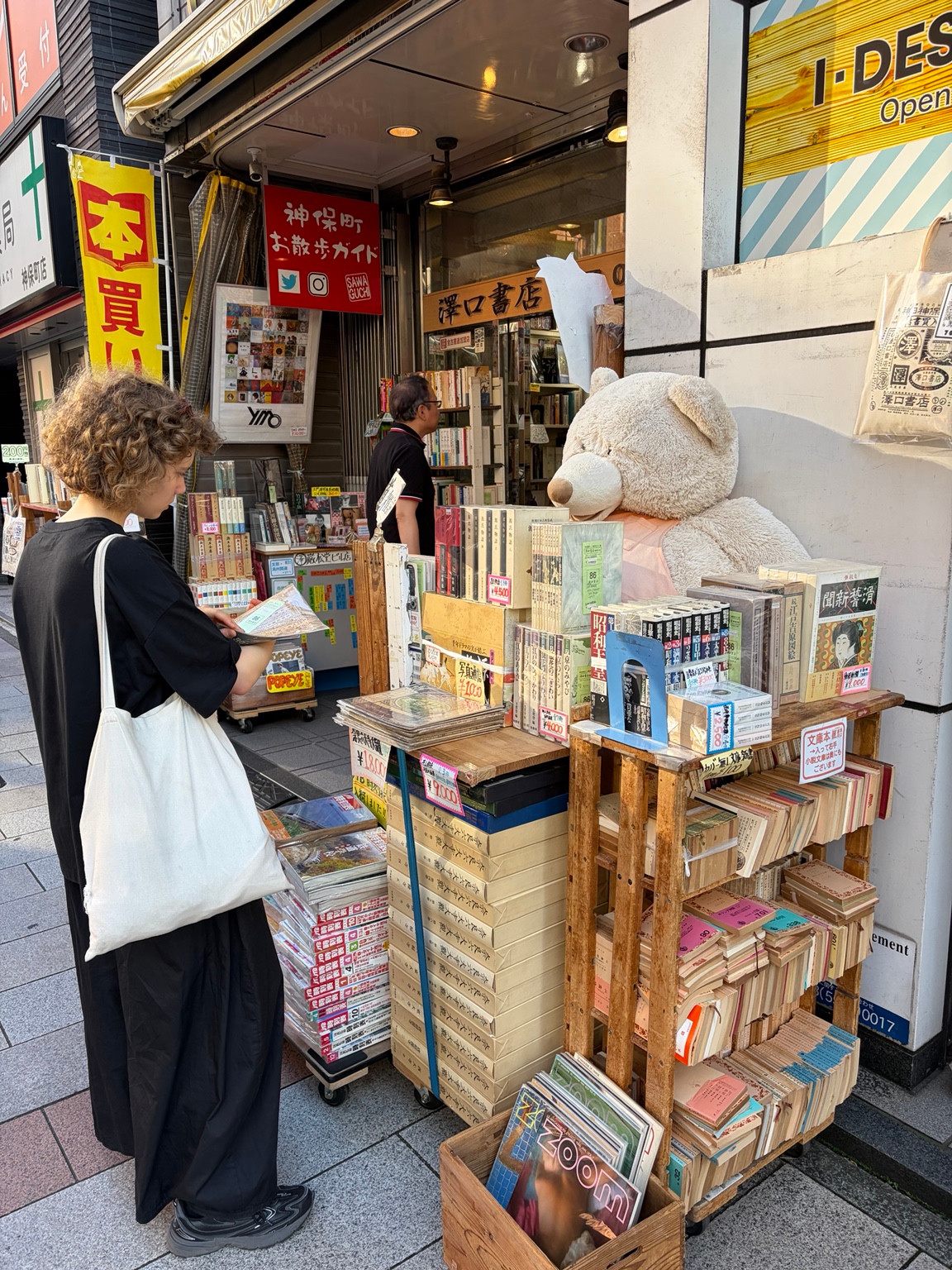
Jimbocho is a Tokyo neighbourhood worth getting to know slowly with children. It grew around students’ demand for books, and its nearby streets still bring specialist second-hand shops, new picture books, manga and foreign-language reading together. A short walk can reveal how people of different generations and interests have read.
For international families, familiar pictures and stories offer a way into Japanese life and history, with room for connections to home. This guide begins with the neighbourhood’s background, then suggests a family route and the reading and cultural discoveries to look for along the way.
Why so many bookshops here? It began with students
In Tokyo’s Chiyoda ward, Jimbocho’s bookshops cluster along Yasukuni-dori and the surrounding streets. Its beginnings as a book town go back to the early Meiji period. Schools opened on former samurai estates and other sites; students brought demand for textbooks and reading material, and bookshops followed. Chiyoda’s local history names Kaisei School, Tokyo English School and Gakushuin among the schools connected with this change.
That history also helps explain why browsing, lunch and coffee fit so naturally together here. Meiji University Museum’s account of the Kanda student district places bookshops alongside lodgings, restaurants and general stores. Young people came to study, and needed somewhere to live their everyday lives too.
The shops still have distinct specialities: film, art, foreign-language books, children’s literature. Different readers have left different books behind. With a child, there is something interesting to notice beyond the sheer volume of old books: how a city makes room for so many kinds of curiosity.
What can children and students take from book town?
For younger children, choosing for themselves is a useful beginning: find something that genuinely interests them among animals, science, sport and stories, enter through the pictures, then explore the words. Specialist shops give those interests somewhere to lead, with reading choices beyond schoolbooks.
Older students can use the neighbourhood to practise comparison and questioning. How do older and newer books on the same subject differ? What clues do covers, language, illustrations and publication dates offer? Where could you check a claim? Treating a book as something with an author, a date and a point of view can turn browsing into a small independent investigation.
In multilingual families, editions of the same story can become common ground. Adults and children need not have identical Japanese reading skills: a picture or a familiar character may be enough to begin a conversation.
A suggested route: picture books first, then east for English reading
Start at Jimbocho Station on the 2-chome side, near exits A1 and A2. Group the two nearby children’s book stops together, then head east along Yasukuni-dori towards 1-chome. The order is Book House Cafe → Miwa Shobo in Kanda Kosho Center → the little bookshop tokyo. Finish around Suzuran-dori for food before returning to Jimbocho Station.
Allow roughly two to three hours for this suggested route, including browsing and a break. With a child of around seven, the first two stops make a shorter outing; keep the last stop if English books are the priority. Check opening days first and skip a closed shop without losing the rest of the walk.
Stop 1 | Book House Cafe: begin with a picture your child loves
A picture-book specialist and cafe, mainly selling new books, with exhibitions of original artwork and events. Address: Kanda-Jimbocho 2-5, Kitazawa Building, 1F. Let your child begin with an image they love and choose a story to read again at home.
Stop 2 | Miwa Shobo: children’s books across generations
A second-hand children’s specialist for older picture books, stories and publications from different eras. Address: Kanda-Jimbocho 2-3, Kanda Kosho Center, 5F. It also lists foreign-language children’s books; ask about current English stock.
Stop 3 | The little bookshop tokyo: look for English reading
This shop directly imports bargain and outlet stock from UK and US publishers, with a children’s category online. These are discounted new books rather than ordinary second-hand copies. Address: Kanda-Jimbocho 1-41-1, Sanseido No. 2 Building, 1F. Choose around a child’s interests and English reading experience as well as the age label.
What everyday worlds do children’s books contain?
One way in is to look beyond the best-known characters towards things a child recognises from daily life. Miwa Shobo’s online catalogue, for example, lists Kazuo Iwamura’s 14-hiki no Hikkoshi, a story about a family of fourteen mice finding a new home and building together beside tree roots. Their surroundings, the jobs each family member takes on and the details of living together are all part of the story.
For a family reading across languages, those details offer a practical starting point. Look for who is carrying things and who is helping; then describe the page in whichever language feels familiar. Understanding a relationship in a picture can come before reading a full Japanese sentence. From there, the conversation might turn to your own home, a move, grandparents or siblings.
Science picture books such as Gakken’s Kagaku Ehon range bring observation and discovery into children’s reading. Picture books, science books, manga, magazines and their supplements invite different ways of reading: studying an image, following a story, understanding a phenomenon or taking something off the page to play with. Miwa Shobo’s categories include manga, magazines and supplements alongside children’s books from different periods.
Seeing these together is more revealing than trying to give “Japanese children” one shared set of interests. Family life, curiosity about nature, fantasy and entertainment can all belong in a child’s world. The old-book district brings choices from different generations into the same afternoon.
Astro Boy: a familiar face, and another question
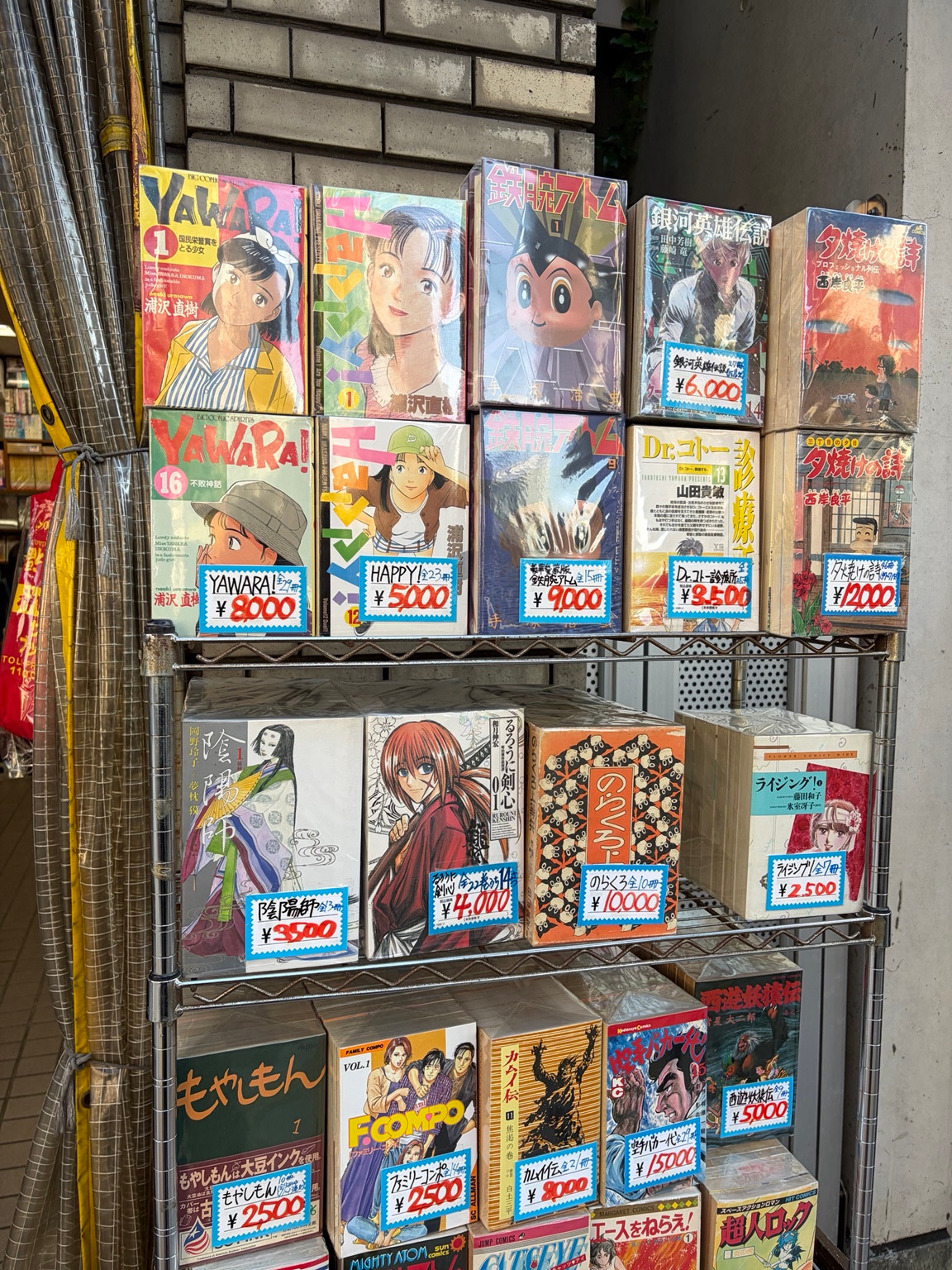
Manga shelves can bring very different works together, as in the pictured selection of Astro Boy, YAWARA! and Happy!, among other titles. A child might recognise a face while a parent remembers a particular edition. The same shelf also shows how varied manga’s subjects and readers are; these are not all books for young children.
Astro Boy offers an especially interesting starting point. The official Tezuka account of the character describes both an imaginative relationship with science and a question about whether science and people can coexist. It also discusses the unfair treatment he faces as a robot. A flying hero on a cover can lead to a much larger story.
For a child today, the questions can be simple. Can a robot have feelings? How should we treat someone who is different from us? These are questions we can bring to the work, without turning a walk into a literature lesson. Children of different generations may answer them through very different experiences.
Clues to how children played
Beyond books, paper cards and stickers preserve clues to children’s culture. The pictured pile brings colourful round cards and character stickers together. The round cards bring to mind menko, a traditional Japanese game in which players slap a thick paper card onto the ground, using the rush of air to flip another card. A printed character can become something to play with, compete over and exchange.
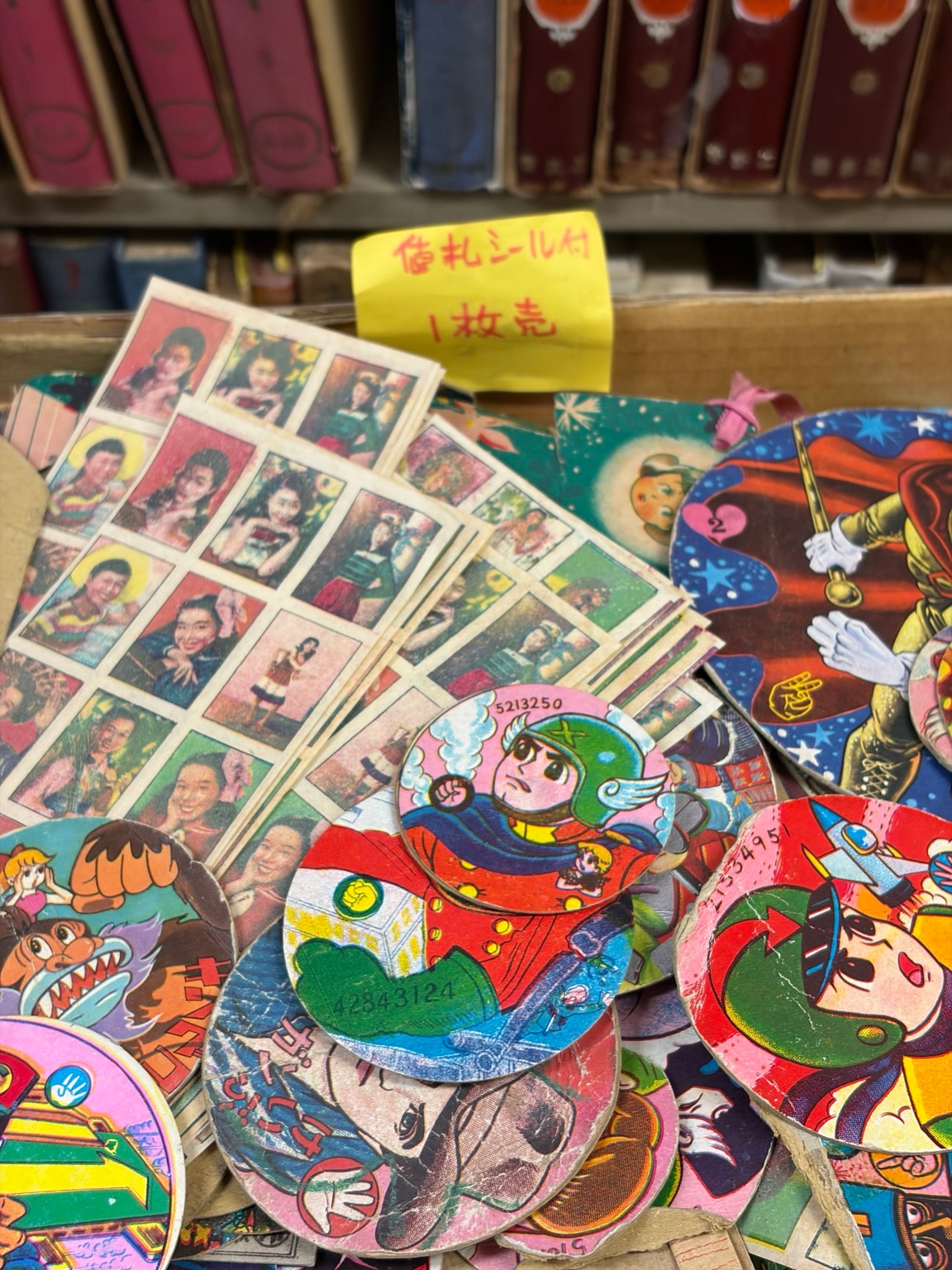
Looking at manga alongside these small paper objects suggests how characters can travel beyond a book into children’s games and collections. A parent might share what they collected, then compare it with today’s cards, stickers and character merchandise. There are changes, and some readily recognisable similarities.
Telephone and old transit cards open up a quieter part of daily history: how people made calls before mobile phones, or took the train. Something completely ordinary to an adult can belong to an unfamiliar world for a child. Ask the shop before handling or unfolding delicate paper items. If menko catches your interest, make a set from card at home and try it.
For international families, familiar things can turn up here too
Another pleasure of Jimbocho is seeing material in different languages on the same street. One display is labelled as 2027 foreign-language calendars. The cat on its cover sits beneath the German word Katzen and the English word CATS. These are calendars rather than English children’s picture books, but the same cat with two different labels is a small invitation to notice and compare words.
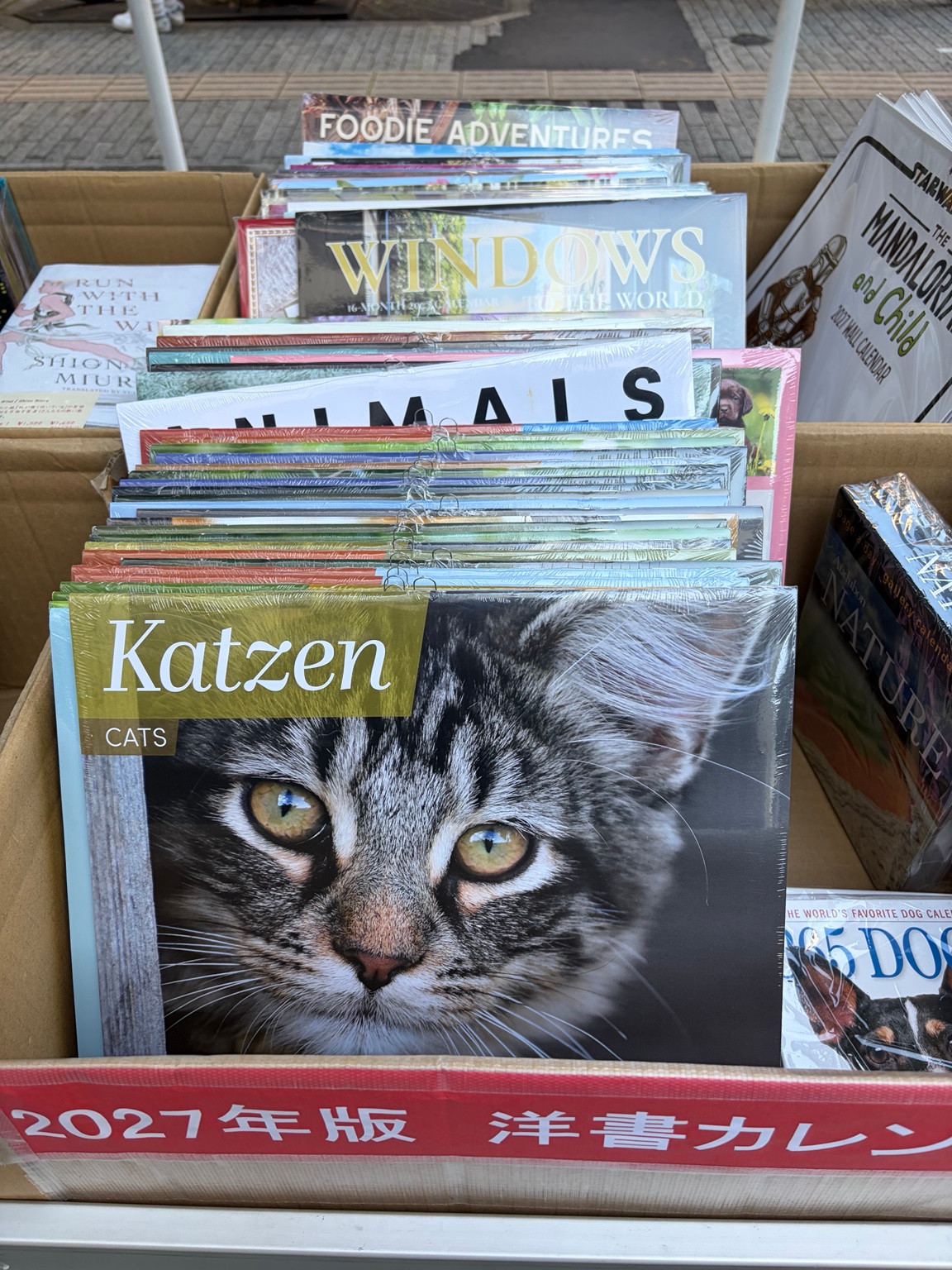
Children’s books show similar exchanges. Miwa Shobo lists Japanese picture books, translated picture books and foreign-language picture books separately; its catalogue also includes The Three Little Pigs and folk tales from Nepal and China. A Japanese bookshop can lead a family back to a story already familiar from home.
If you find a Japanese edition of a story you know, compare its title, character names and illustrations. Why can the same story look different? A child need not choose between Japanese books and books in a home language. Two languages can meet through one picture or character. That is a particularly rewarding way for an international family to explore these shelves.
Make room for lunch and a pause
Bookshops and places to eat have long been part of the student district’s everyday life. After reaching 1-chome, look around Suzuran-dori for lunch or a snack, alternating browsing with time to rest. Sitting down to talk about a book that caught your child’s eye is part of the outing too.
Check weekend arrangements before travelling. Miwa Shobo opens 11am–5pm on Sundays and public holidays, closing on the first and third Sundays, with separate August arrangements. Book House Cafe’s bookshop opens 11am–6pm and closes over the New Year holiday; weekend cafe seats cannot be reserved. The little bookshop tokyo announces hours on its official Instagram. If English books are the main reason for your visit, ask about stock too.
Jimbocho Station exit A2 has a lift; individual shop entrances and access to upper floors need checking separately. Yasukuni-dori carries traffic, so use pedestrian crossings. When buying old books, consider condition, edition and whether a price is for a complete set. Agreeing a budget with your child makes choosing easier.
In late October, children’s books come out into the street
The Jimbocho Book Festival on October 24 and 25, 2026, adds a livelier option. Its children’s book area, Kodomo no Hon Hiroba, runs from 10am to 5pm both days in the outdoor public space at Jimbocho Mitsui Building. It includes children’s book stalls, free papermaking, family programmes and a free Conan sticker rally for children of elementary-school age and younger.
This is a festival-only venue rather than a permanent children’s centre. The event is cancelled in rain, so check the official announcement before heading out.
Something to take home: a little of each other’s childhood
We recommend Jimbocho to international families because it makes exploring Japan wonderfully specific: a picture book about family life, a robot imagining the future, a paper card once used in a game, a familiar story in another language.
A child may discover something new while a parent remembers something old. When those two ways of looking meet at the same shelf, an afternoon’s walk gains a little more meaning.